
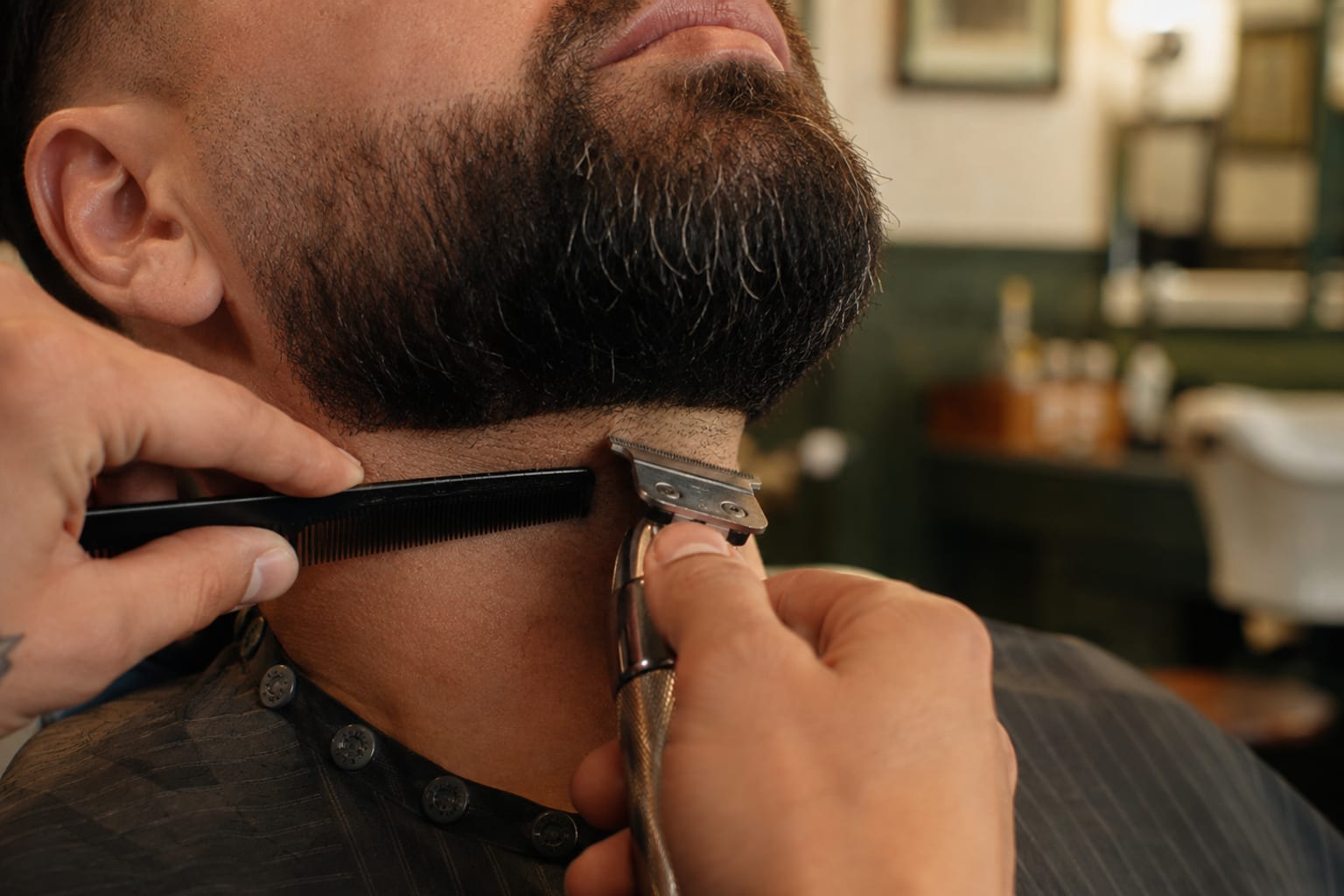
Your beard neckline is the first thing to go fuzzy between barber visits, and the fix is simpler than most people think: find the right line, trim it with a guard rather than a bare blade, and keep the skin underneath properly cleansed and moisturized. Get those three things right and you can comfortably stretch the gap between professional trims without the collar area looking scruffy or feeling sore.
This is exactly the kind of finishing work you will have seen a barber do with a comb and trimmer, working the line in close against the skin before blending it back into the beard. You can manage a decent amount of that yourself at home, as long as you know where the line sits and how to treat the skin once autumn weather starts working against you.
How Do You Find Your Beard Neckline at Home?
Before you trim anything, you need to know where the line actually belongs. The neckline is simply the lowest point your beard grows to before your neck skin takes over, and it should look like a natural, slightly curved boundary rather than a hard shelf.
A good starting point is to look at where your current barber has set the line and simply maintain it, rather than guessing a new position every time you pick up a trimmer. If you are between styles or growing a beard out, our guide to growing a beard out covers how the shape evolves as length builds, which is useful context before you start reshaping anything at home.
The safest rule for home maintenance is to only ever tidy hair below the existing line. Trying to move the line itself, especially pushing it higher up the neck, is where most home trims go wrong and end up needing a full professional reset anyway.
What Tools Do You Actually Need Between Visits?
You do not need a full kit to keep a neckline tidy for a couple of weeks. The basics are:
- ◆A trimmer with a guard attachment, rather than a bare blade or disposable razor
- ◆A fine-toothed comb to lift and check the line before and after trimming
- ◆A mirror positioned so you can see your neck from slightly below, not just straight on
- ◆A gentle cleanser and a moisturiser or beard oil for afterwards
Keep your trimmer guard on for neckline maintenance work. A bare blade shaves far closer to the skin than a guard does, and that closeness is exactly what increases the risk of irritation, as covered in the next section.
How Do You Trim a Clean Neckline Step by Step?
- Wash and dry the area first. As the American Academy of Dermatology explains,
healthy-looking facial hair starts with healthy skin, and with the right skin care it is possible to prevent problems like dandruff, ingrown hair, acne, and itch.
- Comb the beard down so you can see exactly where the existing line sits against the skin.
- Fit a guard on your trimmer rather than using it bare.
To help prevent irritated skin, apply a shaving oil, cream, or gel before trimming your beard and use an electric razor to trim it.
- Work in small sections along the existing line, following the direction the hair grows rather than against it.
Shave in the direction that your hair grows, since shaving against the grain can cause ingrown hairs in some people.
- Use short, light strokes rather than long sweeps, and go over each section only once if you can help it. According to NHS 111 Wales guidance on ingrown hairs,
you should use as few strokes of the razor as possible and rinse the razor after every stroke.
- Rinse the trimmer or blade between passes to stop clogged hair dragging on the skin.
- Finish with a cool, damp cloth held against the area for a moment.
Holding a cool, wet cloth to your skin after shaving helps reduce irritation.
- Apply a light moisturiser or beard oil straight away.
Apply your moisturiser, beard conditioner, or beard oil immediately after you shave.
If in doubt, trim less than you think you need to. It is always easier to take a little more off in a day or two than to wait for an overcut line to grow back.
Why Does the Collar Area Flare Up More in Autumn?
The neckline sits right where your collar, scarf or jumper rubs against your skin all day, and that friction does not let up once the weather turns. Indoor heating also dries the air out, which can leave already-trimmed skin tighter and more prone to flaking and itching. We cover the wider picture of dry, itchy skin through the colder months in our guide to dry, itchy scalp in autumn, and a lot of the same thinking applies to the skin under a beard.
Shaved or trimmed skin is also simply more vulnerable than skin that has never been cut close.
The right skin care can prevent problems like dandruff, ingrown hair, acne, and itch beneath a beard
, and that routine matters more, not less, once scarves and collars are added into the mix.
How Do You Stop Redness and Ingrown Hairs Around the Neckline?
Ingrown hairs are one of the most common complaints in the neckline area, and they are also one of the most preventable.
Ingrown hairs cause bumps, which are often itchy, where a hair has grown back into the skin.
The British Association of Dermatologists explains that
pseudofolliculitis, also known as shaving bumps or razor bumps, is inflammation of hair follicles and surrounding skin, caused by hairs trapped beneath the skin surface
, and that
this process is more likely to occur in curly hair
, which is exactly the hair type found in a lot of fuller beards.
A few habits make a real difference around the neckline:
- ◆Shave or trim in the direction the hair grows. The British Association of Dermatologists' advice for people prone to bumps includes to
shave in the direction of hair growth and avoid stretching the skin tight
.
- ◆Keep your blade or trimmer sharp. The NHS advises that you should
not use a blunt razor
when tidying areas prone to ingrown hairs.
- ◆Do not shave the same patch of skin twice in one go.
Using single blades and shaving every second day rather than daily, if possible, is also recommended
for anyone who gets regular bumps.
- ◆Leave a little stubble rather than cutting as close as possible.
Not shaving too close, and leaving some stubble, can stop bacteria getting in
.
- ◆If you are prone to ingrown hairs, a gentle exfoliating scrub helps.
Dr Rossi recommends using a gentle exfoliating scrub one to two times per week for anyone prone to ingrown hairs, moisturizing immediately afterward.
- ◆Never pick, scratch or squeeze a bump that appears.
Doing so can damage your skin and lead to infection.
If bumps do appear and you keep trimming the same area regardless, they tend to stick around. The British Association of Dermatologists is direct about this:
the only certain cure is to stop shaving, waxing or tweezing, and it may take four to six weeks for inflammation to settle and for the hairs to reach a length where ingrowth will not recur.
In practice, that usually means letting your barber take the line back gradually at your next visit rather than fighting the same irritated patch at home every few days.
Finally, try to leave the area alone between trims.
Touching your beard spreads germs and dirt from your hands to your face, which can cause skin problems beneath your beard.
When Should You Call In a Professional?
Home maintenance is fine for keeping a line tidy for a week or two, but it has limits. If your neckline has crept higher than it should, if the shape looks uneven from side to side, or if you are growing your beard into a different style altogether, that is a job for your barber rather than a bathroom mirror.
At Georges Barbers, beard grooming covers both a maintenance trim and a full reshape, and our full guide to beard grooming in Amersham explains the difference between the two services and how often most clients come in. A good rule of thumb is to let a professional fully reset the neckline every few weeks, and use the home routine above purely to keep things tidy in between.
Beard trims are available as a walk-in service seven days a week, so there is no need to book ahead if your local shop suits your day. If you would rather lock in a specific time, book your visit online Monday to Friday.
When Should You See a Pharmacist or GP Instead?
Occasional redness after a trim is normal and usually settles within a day. Persistent bumps, pain or infection are a different matter, and that is not something to self-manage with more trimming.
The NHS is clear on ingrown hairs that you should
see a GP if the ingrown hair or area around it is very painful, hot, red or swollen, or if you have a high temperature or feel hot, shivery or very unwell
. For anything milder,
a pharmacist can advise on creams and lotions to help itching, shaving and hair removal products to help prevent irritation, exfoliating products, and a mild antiseptic to help prevent infection
. We are not medically trained and cannot diagnose a skin problem for you, so if anything around your neckline looks infected, will not heal or keeps coming back, a pharmacist or your GP is the right place to go.
Visiting Georges Barbers in Amersham and Nearby
Whatever state your neckline is in right now, the quickest fix is to let a proper barber reset it properly and take it from there. We have been doing exactly that at 11 Chesham Road since 1991, and beard trims and reshapes are available as a walk-in service every day of the week, alongside full haircuts.
We see regulars travelling in from right across the area, including Amersham, Chesham, Beaconsfield, Chalfont St Giles and Chalfont St Peter, Little Chalfont, Gerrards Cross and High Wycombe, as well as Great Missenden, Chorleywood and Hazlemere. Walk in any day for a trim, or book your visit online Monday to Friday if you would rather have a set time in the diary before the autumn rush for appointments builds up.