
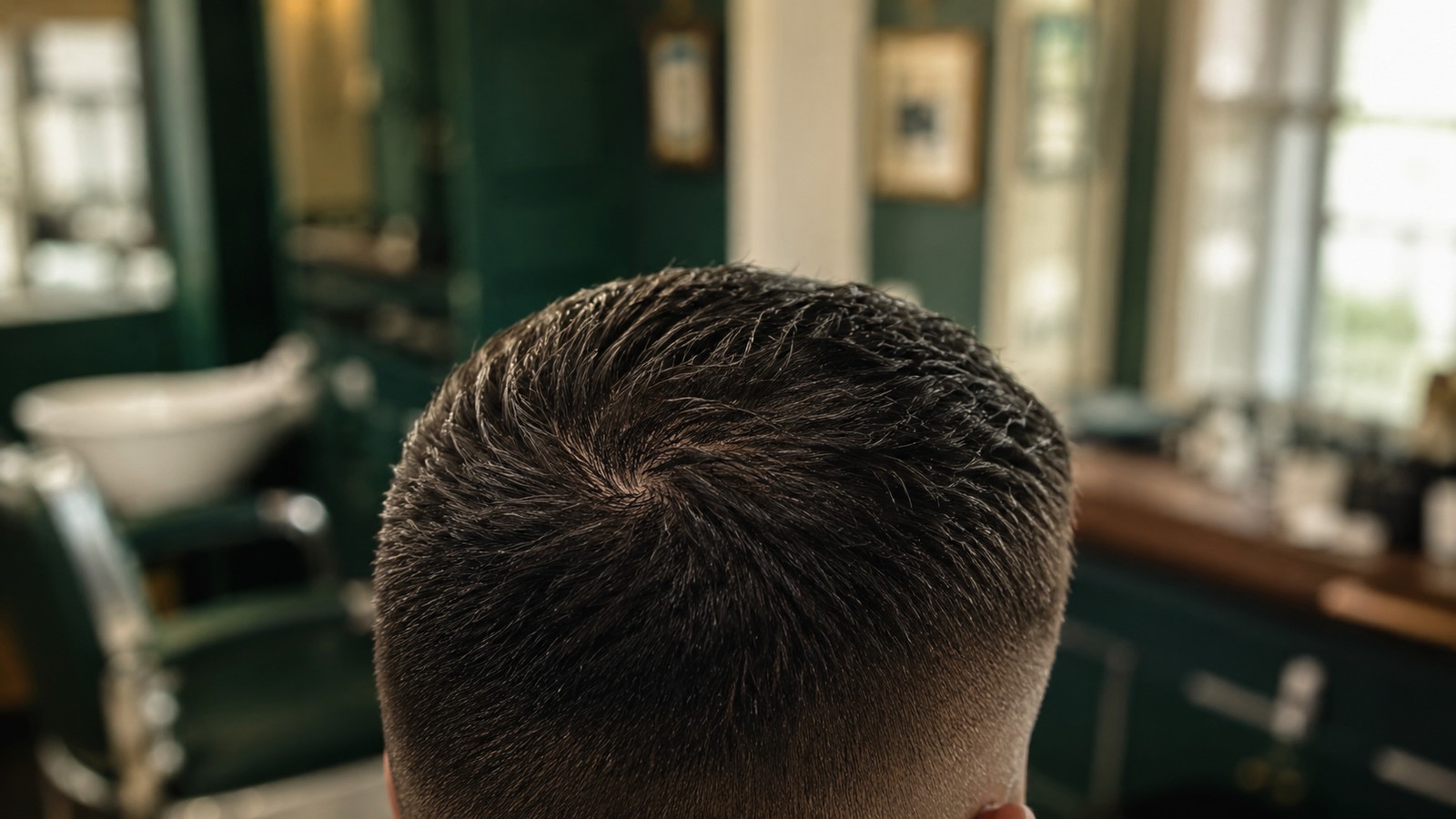
- Why does your scalp get worse when the weather turns?
- Is it dandruff or a dry scalp?
- What is seborrhoeic dermatitis, and could you have it?
- Dry scalp, dandruff and seborrhoeic dermatitis, side by side
- What actually clears it up?
- Are you washing your hair wrong?
- Can your haircut make the flaking more obvious?
- When should you stop self-treating and see a GP?
- Where does Georges fit in?
- Sources
You notice it in September. A dark jacket comes out of the wardrobe, and by lunchtime there is a dusting across the shoulders that was not there in July.
Georges Barbers has been cutting hair in Amersham since 1991, and every autumn brings the same question into the chair. Here is what is actually happening, and what is worth doing about it.
Why does your scalp get worse when the weather turns?
Because cold weather is a genuine trigger, not an excuse you are making for yourself.
The NHS says plainly that "stress and cold weather may also make dandruff worse". Dermatologists describe the same pattern in stronger terms. DermNet notes that seborrhoeic dermatitis, the condition behind a lot of persistent scalp flaking, shows "winter flares, improving in summer following sun exposure".
So if your scalp behaves itself all summer and starts misbehaving the week the heating goes on, you are not imagining it. That is the documented pattern.
Is it dandruff or a dry scalp?
They are two different problems that look almost identical, which is why so many people treat the wrong one for years.
The American Academy of Dermatology draws the line like this. Dandruff is "small pieces of dry skin flaking off your scalp", and it is often linked to seborrhoeic dermatitis, which involves a yeast that lives on the skin. A dry scalp is different: it happens "when skin loses too much water", usually because a product has stripped the natural oils out, or because the air around you has very little moisture in it.
The AAD is honest that both cause itching and flaking, which makes them hard to tell apart by eye. A few things do point one way rather than the other:
- Flakes that look greasy or yellowish, sitting on redder skin, lean towards dandruff or seborrhoeic dermatitis
- Small, dry, white flakes with skin that feels tight elsewhere too, such as your hands and shins, lean towards a dry scalp
- Flaking that comes and goes in cycles rather than steadily leans towards dandruff
- Flaking that started the week you switched shampoo leans towards the shampoo
If you are genuinely unsure, the practical move is to treat it as dandruff first, because an anti-dandruff shampoo is cheap and the answer arrives within a few weeks.
What is seborrhoeic dermatitis, and could you have it?
It is a common, long-running form of eczema that settles on the oiliest parts of the body, and a lot of men have a mild version without ever putting a name to it.
DermNet describes it as "a common, chronic, or relapsing form of eczema/dermatitis that mainly affects the sebaceous gland-rich regions of the scalp, face, and trunk". On the scalp it shows up as scaly patches or general scale, sometimes with itching, sometimes with barely any discomfort at all. A proliferation of a yeast called Malassezia is believed to play a part.
The reason it matters here is the pattern. Because it flares in winter and eases with summer sun, it is often the real answer when someone says their scalp is only ever a problem between October and March. DermNet also notes that in adults it frequently needs long-term maintenance rather than a one-off course of treatment, which is worth knowing before you decide a shampoo has failed.
Dry scalp, dandruff and seborrhoeic dermatitis, side by side
It helps to see the three lined up, because the differences are small and the treatments are not.
- Dry scalp. Skin that has lost too much water, per the AAD. Fine white flakes, skin often tight elsewhere too, worse in dry indoor air. Responds to gentler washing and less stripping product. An anti-dandruff shampoo will not do much for it.
- Dandruff. Flaking linked to a yeast that lives naturally on the skin. Tends to come and go rather than sit steadily. Responds to an anti-dandruff shampoo with the right active ingredient.
- Seborrhoeic dermatitis. A chronic or relapsing eczema affecting the oil-rich areas, per DermNet. Scalier patches, sometimes redness, often the same areas of the face too, such as the sides of the nose and the eyebrows. Responds to medicated shampoo but usually needs keeping on top of rather than curing.
The overlap between the last two is deliberate. The AAD describes dandruff as often linked to seborrhoeic dermatitis, so in practice they sit on a spectrum rather than in separate boxes. Where it matters is that the middle one usually clears with a shampoo and the third one usually comes back.
What actually clears it up?
An anti-dandruff shampoo with the right active ingredient, used properly, for long enough.
The NHS names four to look for: zinc pyrithione, ketoconazole, coal tar and salicylic acid. The AAD's list is longer and adds sulfur and selenium sulfide. Any of them is a reasonable starting point, and if one does nothing, switching to a different active ingredient is more useful than switching to a different brand with the same one.
Two details make more difference than which bottle you buy:
- Give it time. The NHS says to use the shampoo for up to four weeks to see whether your dandruff improves. Most people give up inside a fortnight and conclude it did not work.
- Give it contact time. The AAD notes that some dandruff shampoos need to sit on your scalp for five to ten minutes before rinsing. Lathering and rinsing straight away wastes the active ingredient.
One thing worth saying clearly, because it embarrasses people unnecessarily: the NHS states that "dandruff is not caused by poor hygiene". It is not a cleanliness problem and washing harder will not fix it.
Are you washing your hair wrong?
Possibly, and the right answer depends on your hair type rather than on any general rule.
The AAD splits it two ways. If your hair is fine, straight or oily, you can wash frequently, potentially daily, and use the dandruff shampoo twice a week. If your hair is coarse, curly or coily, wash as needed and use the dandruff shampoo roughly once a week, because more than that will dry the hair out. For textured hair the AAD adds a specific instruction: "only apply the dandruff shampoo to your scalp", and let the ordinary conditioner look after the lengths.
The autumn part of this is water temperature and central heating. Very hot showers and dry indoor air both pull moisture out of skin, and your scalp is skin. If your scalp problem arrived with the heating, turning the shower down a little is free and worth trying before you buy anything.
Can your haircut make the flaking more obvious?
Yes, and this is the part a barber can genuinely help with.
Flaking shows more on a short, tight cut with high contrast, because there is less hair to catch it and darker skin showing through makes white scale stand out. It also shows more on very dark hair against a very dark jacket, which is why September is when everyone notices it.
If you are dealing with a flare, a slightly longer, softer shape buys you cover while the shampoo does its work. It is the same trade-off we talk about in the skin fade guide: a bit less definition, a bit more forgiveness. Once it settles, go back to whatever you actually wanted.
Tell your barber what is going on. Nobody at Georges will be remotely surprised, a comb over a flaking scalp is a normal Tuesday, and it changes how carefully we work and what we suggest.
When should you stop self-treating and see a GP?
When you have given a proper anti-dandruff shampoo a fair run and it has not shifted.
The AAD is direct about this. If over the counter treatment fails, "it is time to see a board-certified dermatologist for a proper diagnosis and treatment plan", because persistent scalp trouble can be psoriasis, a fungal infection or eczema rather than ordinary dandruff. In the UK that route starts with your GP.
Bring it forward if the skin is broken, weeping, painful or spreading, or if there is hair loss in the flaking patches. Those are not things to work through with shampoo.
Nobody in a barbershop can diagnose you, including us. What we can do is tell you honestly whether what we are looking at seems like ordinary autumn dryness or something we would want a GP to see.
Where does Georges fit in?
We cut hair, and we are straight with you about what a haircut can and cannot fix.
Walk in any day of the week for a haircut, skin fade or beard trim at 11 Chesham Road. No appointment needed. If you would rather have a set time, book online Monday to Friday. Ear piercing is the one service that always needs an appointment.
Full details are on the haircuts page, and men come in from across Amersham, Chesham, Little Chalfont, Chalfont and Beaconsfield. If hard water is your other autumn suspicion, we have written about what the evidence actually says on that too.
Come in, get it cut, and stop wearing the navy coat until it settles.
Sources
- NHS, Dandruff
- DermNet, Seborrhoeic dermatitis
- American Academy of Dermatology, Is your dry scalp something more serious?
- American Academy of Dermatology, How to treat dandruff
Frequently Asked Questions
Why does my scalp get flaky in autumn?
Cold weather is a recognized trigger. The NHS lists cold weather alongside stress as something that makes dandruff worse, and DermNet describes seborrhoeic dermatitis flaring in winter and improving in summer with sun exposure. Dry indoor air from central heating adds to it.
How do I tell a dry scalp from dandruff?
They look similar and both itch. The American Academy of Dermatology describes dandruff as flaking often linked to a yeast on the skin, and a dry scalp as skin that has lost too much water, usually from harsh products or dry air. Treating for dandruff first is the practical test.
How long should I use an anti-dandruff shampoo before giving up?
Four weeks. The NHS advises using an anti-dandruff shampoo for up to four weeks to see whether things improve. Most people stop after a fortnight. The AAD also notes some shampoos need to sit on the scalp for five to ten minutes before rinsing.
Does dandruff mean my hair is dirty?
No. The NHS states directly that dandruff is not caused by poor hygiene. It is linked to a yeast that lives naturally on skin, or to skin conditions such as eczema. Washing more aggressively will not fix it and can dry the scalp further.
When should I see a doctor about my scalp?
When over the counter treatment has had a fair run and failed. The AAD advises seeing a dermatologist at that point, because persistent flaking can be psoriasis, a fungal infection or eczema. Go sooner if the skin is broken, painful, weeping or there is hair loss.
Do I need an appointment at Georges Barbers?
Not for haircuts. Walk in any day of the week at 11 Chesham Road, Amersham, with no appointment needed for haircuts, skin fades and beard trims. Online booking is available Monday to Friday if you want a set time. Ear piercing always requires an appointment.
By the team at Georges Barbers, cutting hair in Amersham since 1991.