
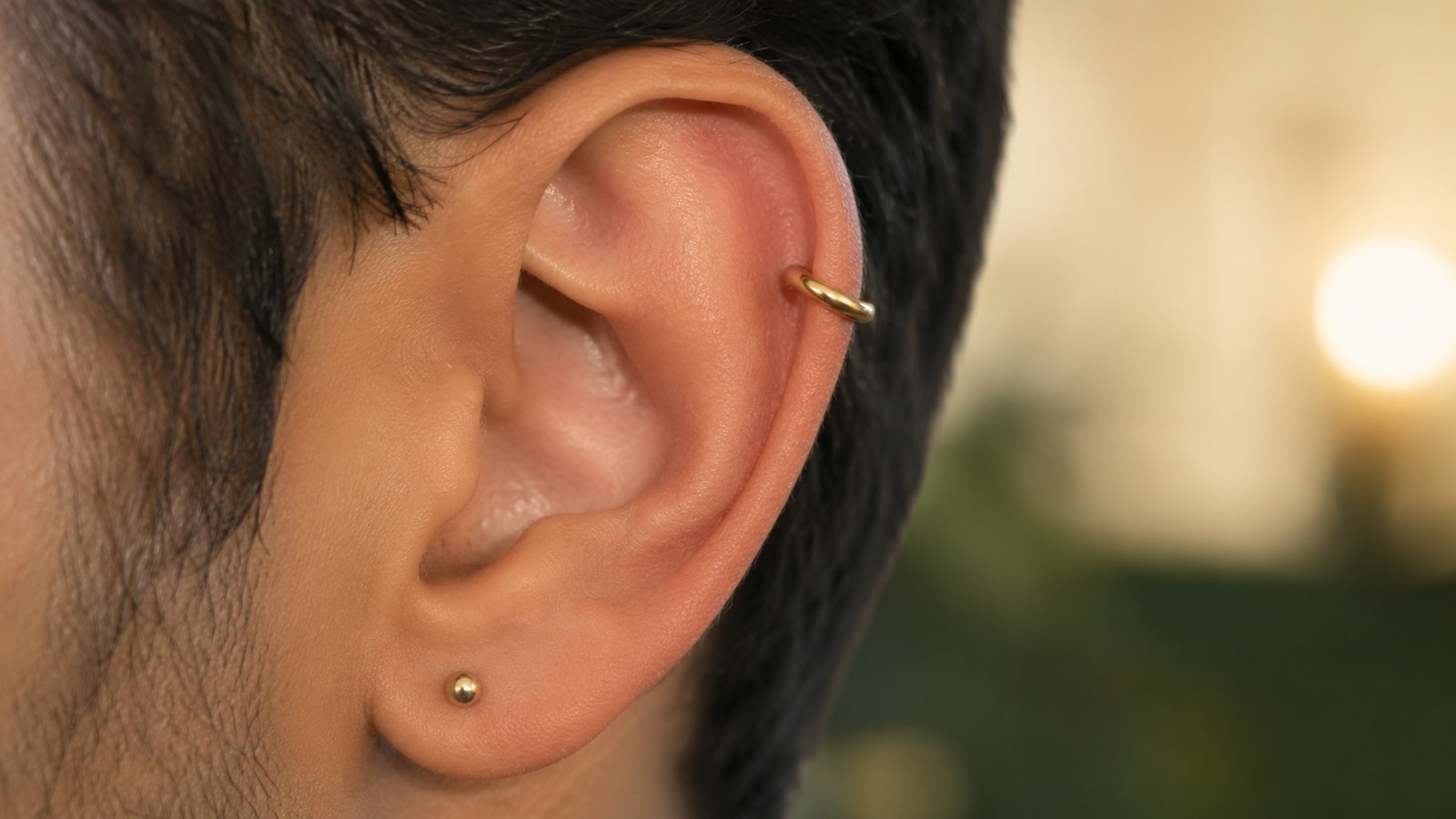
- What placements can you get at Georges?
- Why does cartilage take so much longer than the lobe?
- Which placements carry more risk, and why?
- How long should you leave the jewellery in?
- Why do the healing times you read online all disagree?
- Which placement should you start with?
- What jewellery should you ask for?
- How do you look after it?
- How do you book?
- Sources
Most people arrive having already decided where they want it, usually from a photo. Then they find out that the placement they picked is the slowest healing one on the ear.
Georges Barbers has been piercing ears in Amersham since 1991, and this is the conversation we have most often. Here is what actually separates the placements, so you can pick with the full picture rather than half of it.
What placements can you get at Georges?
Lobe, helix, tragus and flat, with the choice settled at a consultation before anything happens.
Briefly, from our ear piercing page:
- Lobe. The standard ear lobe piercing and the most common first piercing. Available as a single or double.
- Helix. Through the cartilage on the outer rim of the ear. A clean, versatile placement that suits a lot of jewellery styles.
- Tragus. The small triangle of cartilage directly in front of the ear canal. Discrete and popular.
- Flat. On the flat inner cartilage of the ear. A bolder placement that carries larger statement jewellery.
Every appointment starts with a consultation covering placement, jewellery choice and anything you want to ask before we begin. If you have a placement in mind that is not on that list, ask at the consultation rather than assuming either way.
Why does cartilage take so much longer than the lobe?
Because cartilage has no blood supply of its own, and healing runs on blood supply.
This is not barbershop folklore, it is anatomy. StatPearls puts it directly: "The pinna's cartilage is avascular and thus depends on the highly vascularized perichondrium for oxygen and nutritional support." The perichondrium is the membrane wrapped around the cartilage, and it is doing all the work.
The lobe is different tissue entirely. It is soft, fleshy and well supplied with blood, which is why it settles comparatively quickly and forgives more.
That single difference explains almost everything else on this page. Slower healing, higher infection risk, more care needed, and less room for error.
Which placements carry more risk, and why?
Anything through cartilage, and the reason follows straight from the point above.
StatPearls states that "transcartilaginous ear piercings carry a greater risk of infection and abscess formation than lobule piercings", and goes further: "the cartilage's scanty blood supply makes it especially susceptible to infection even with careful implementation of the aseptic technique". That last phrase matters. It is saying the risk does not disappear just because the piercing was done properly.
It also notes that the growing popularity of cartilage piercings has been implicated in a rise in perichondritis cases, which is inflammation of that membrane doing the healing.
DermNet lists what can go wrong across body piercing generally: contact dermatitis, keloid and hypertrophic scarring, granulomas, abscess, cellulitis and chondritis among them. The pathogens most frequently isolated are Pseudomonas aeruginosa and Staphylococcus aureus.
None of this is a reason to avoid cartilage piercings. It is a reason to go into one knowing it is a longer commitment than a lobe, and to take the aftercare seriously rather than treating it as optional.
How long should you leave the jewellery in?
Longer than you want to, and the clearest published figure comes from the American Academy of Dermatology.
The AAD's guidance is to "leave your jewelry in your new piercing for six weeks or more, even at night". The "or more" is carrying weight there, and for cartilage it is carrying most of the weight.
The temptation to swap jewellery early is the single most common way people set their own healing back. A piercing that looks settled on the outside is not necessarily settled through the channel.
Why do the healing times you read online all disagree?
Because there is no agreed table, and most of the confident ones you will find are selling jewellery.
We looked for a healing-time figure per placement from a source we would be willing to put our name to. Health authorities and dermatology bodies describe the difference between lobe and cartilage clearly, and the AAD gives the six weeks or more figure, but we could not find a per-placement table from a health authority. Almost every neat chart of exact weeks per placement traces back to a retailer or a studio blog.
So we are not going to publish one. What we will tell you is the shape of it, which is the part everyone actually agrees on:
- The lobe is the fastest healing placement on the ear
- Every cartilage placement is substantially slower than the lobe
- Healing is not linear, and a piercing can look fine for weeks and then get irritated again
- Your own healing depends on your body, the placement and how well you look after it
Anyone quoting you an exact number to the week for a helix is guessing with more confidence than the evidence supports.
Which placement should you start with?
If it is your first, the lobe, for reasons that have nothing to do with how it looks.
It is the fastest healing placement, the most forgiving of a mistake in aftercare, and the easiest to live with day to day. It also tells you something useful about yourself before you commit to a harder one: whether you can actually keep up an aftercare routine for months rather than days.
A few practical things that push people one way or the other:
- How you sleep. Any cartilage placement on the side you sleep on will be irritated nightly for a long time. Tragus, helix and flat all sit where a pillow presses.
- Headphones and glasses. Over-ear headphones sit directly on a helix. Glasses arms sit near a tragus.
- Sport and swimming. DermNet advises avoiding public pools and spas while a piercing is healing, and the NHS advises no swimming for the first 24 hours.
- Whether you want it visible. Tragus is discrete, flat is a statement, and that is a personal call rather than a technical one.
If you want a cartilage placement eventually, there is no rule against starting there. Just go in understanding that you are choosing the longer, higher maintenance route.
What jewellery should you ask for?
Something hypoallergenic, and this matters more than the design at the start.
DermNet identifies nickel as the most common allergen in piercing reactions, and recommends hypoallergenic metalware such as surgical stainless steel, niobium, titanium or gold. If you have reacted to jewellery, a watch back or a belt buckle before, say so at the consultation, because that is exactly the information that changes what we put in.
DermNet also notes that people with a personal or family history of keloid or hypertrophic scarring are at highest risk of scarring from piercings. Again, worth raising at the consultation rather than after.
How do you look after it?
Simply, twice a day, and without any of the products people reach for instinctively.
The NHS advice is to use warm, salty water to soften any crusting and dry with a clean paper towel, twice daily. Not cotton wool, which leaves fibres behind. Do not pick the crusting off and do not move the jewellery around when it is dry.
The AAD adds: wash your hands before touching it, wash the piercing gently with a mild, fragrance-free cleanser and water at least once a day, and rinse thoroughly. Specifically avoid hydrogen peroxide and antibacterial soaps, which are harsher than the job needs.
Signs something is wrong, per the NHS: the area is swollen, painful, hot, very red or dark, or there is blood or pus coming out of it. That warrants an urgent GP appointment or a call to NHS 111, because an infected piercing may need antibiotics. The AAD describes the same picture as skin that is sore, red or puffy, or yellowish liquid oozing from the hole.
There is more detail in our ear piercing aftercare guide.
How do you book?
Ear piercing at Georges is by appointment every time and is never a walk-in.
Appointments can be booked online Monday to Friday. Every appointment begins with a consultation covering placement, jewellery and your questions before anything starts. We pierce using a sterile single-use needle rather than a piercing gun, the equipment is opened in front of you, and full aftercare guidance is given before you leave.
Haircuts work the opposite way, so plenty of people walk in for a cut on one visit and book the piercing for another. Full details are on the ear piercing page, and clients come in from Amersham, High Wycombe, Chesham, Little Chalfont and Beaconsfield.
Book the consultation, ask everything you want to ask, and decide the placement there.
Sources
- StatPearls, Pinna Perichondritis
- DermNet, Body piercing
- American Academy of Dermatology, Caring for new piercings
- NHS, Infected piercings
Frequently Asked Questions
Why does a cartilage piercing take longer to heal than a lobe?
Because cartilage has no blood supply of its own. StatPearls describes the ear's cartilage as avascular, depending on the surrounding perichondrium for oxygen and nutrients. The lobe is soft, fleshy tissue with its own good blood supply, so it settles considerably faster.
How long should I leave the starter jewellery in?
The American Academy of Dermatology advises leaving jewellery in a new piercing for six weeks or more, even at night. For cartilage placements the "or more" matters most. Changing jewellery early is one of the most common ways people set their own healing back.
Are cartilage piercings riskier than lobe piercings?
Yes. StatPearls states that transcartilaginous ear piercings carry a greater risk of infection and abscess formation than lobule piercings, and that the cartilage's scanty blood supply makes it especially susceptible even when the piercing is carried out with careful aseptic technique.
Which ear piercing should I get first?
The lobe, if you have not had one before. It is the fastest healing placement, the most forgiving if your aftercare slips, and the easiest to live with day to day. It also shows you whether you can maintain a routine before you commit to a slower cartilage placement.
How do I clean a new ear piercing?
The NHS advises warm, salty water to soften crusting, dried with a clean paper towel, twice a day. Avoid cotton wool. The AAD adds washing your hands first and using a mild, fragrance-free cleanser, while specifically avoiding hydrogen peroxide and antibacterial soaps.
Can I walk in for an ear piercing at Georges Barbers?
No. Ear piercing is by appointment every time and is never a walk-in. Appointments can be booked online Monday to Friday. Haircuts, skin fades and beard trims work the opposite way and are walk-in any day of the week at 11 Chesham Road, Amersham.
By the team at Georges Barbers, cutting hair in Amersham since 1991.